

FACING
THE FIST
THE ROOTS
THE FACTS
3%
OF PEOPLE WITH SEVERE MENTAL ILLNESSES HAVE COMMITTED VIOLENT CRIMES
70% OR MORE
WORKPLACES IN THE U.S. DO NOT FORMALLY ADDRESS WORKPLACE VIOLENCE
12.5%
OF CHILDREN IN THE U.S. EXPERIENCE MALTREATMENT BY THE TIME THEY ARE 18 YEARS OLD
The Science
Violent behaviors are most often associated with mental illnesses, especially as the U.S. tries to find answers to solving gun violence. However, many psychologists discourage the public from associating the two, because of the negative stigma it creates for those with poor mental health. Not only so, but according to a study from Knoll and Annas (2016) under the American Psychiatric Association, states that, "Mass shootings by people with serious mental illness represent less than 1% of all yearly gun-related homicides... [t]he overall contribution of people with serious mental illness to violent crimes is only about 3%... an even smaller percentage... involve firearms."
So, if mental illnesses are not the origins of violent behaviors, what else could it be?
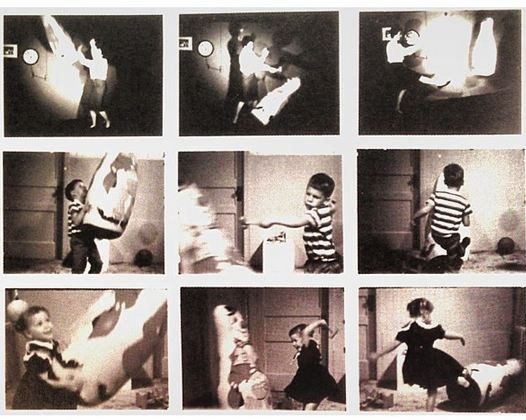
(Figure 1) Screencaps of Bandura's "Bobo Doll Experiment," in which the researchers found the children exposed to the aggression model behaved similarly to what was observed, even coming up with their own means of aggressive actions towards the Bobo Doll.
The social learning theory, as exemplified in Albert Bandura's famous "Bobo Doll Experiment" (Figure 1), explains how violent behaviors are most often learned through imitation or observation. This type of learning happens unconsciously and can happen through observation of a person, or through the media in which children consume. In fact, one's chances of becoming violent increases when they are exposed to violence (Corvo, 2006, p. 117).
Take a look at how witnessing violence can cause everlasting psychological effects on children and their brain's ability to develop:
"Recent discoveries have been made about the invisible workings of the brain in the fields of social psychology, neurology, and epidemiology that have shed some light on how violent behaviors are formed" (Cure Violence, n.d.).
Those that are violent are more likely to develop a mental disorder the consideration of committing violent acts or witnessing violence or victimization is correlated with the onset of depression and anxiety (Slopen et al., 2012). However, if violent behaviors typically precedes mental illnesses, then who is at most risk of becoming a perpetrator of violence in the United States?
Who Commits Violent Acts in the U.S.?
Men are the most vulnerable to commit violent acts in the United States. The number of mass shootings in the United States (U.S.) from 1982 to November 7, 2018, have been committed by 102 men, three females, and one instance of both a male and female (Figure 2; Follman, Aronsen, & Pan, 2018). Generally, women will outlive their male counterparts because men are more likely to engage in reckless behaviors and health risks (Sheppard, 2017). However, the issue is not men, but it is with toxic masculinity and how boys are raised to be more violent, in comparison to girls. The stigma associated with “manliness” in American culture influences the ways in which all generations of children have been raised and taught, thus toxic masculinity and its acceptance as a social norm, has shaped the mold for violent behaviors.
(Figure 2) "Number of Mass Shootings in the United States Between 1982 and November 2018, By Shooter's Gender." Retrieved from Statistica.

TOXIC MASCULINITY: The idea that men should perform exaggerated masculine traits including (but not excluded to): acting aggressively, asserting dominance, showing little emotion and being sexually aggressive
-
It is more common for adolescent boys to consider committing acts of violence, or witness violence or victimization, which is correlated in developing depression and anxiety
-
How supportive of a parental figure a father is is more strongly correlated with whether or not his son(s) will participate in delinquent behaviors (Hoeve et al., 2009)
-
A father’s lack of parental support towards his children has a higher effect than a mother’s neglect, specifically for sons (Bucher, 2014)
-
Men are raised to see aggression as a positive and simple gesture of dominance, while women are more likely to receive negative reactions for displaying the same type of aggressive behaviors (“Gender Differences,” n.d.)
-
Mothers hold infants differently based on sex, handling infant girls more gently than infant boys (Sheppard, 2017)
More on the term
"Toxic Masculinity"
Facing the Fist Anthem
It’s a war made of color,
Yet it’s in black and white.
We’re none like the other,
All fighting the same fight.
The fight for our country,
Preserve it behind walls,
Recognizing gallantry
That honors those with balls…
The balls inside B.B. guns
Sold for child’s play
Gifted to us by the sons
Of the NRA
But it’s for our protection!
Well, tell that to
The victims of rejection
That aspired to:
Come out as gay
And asked to stay
By the people who
Raised you and nursed you
And loved you and left you
Why can’t you think straight?
Because I’ve got a gun, with ammo
Whispering my fate
At this bar in Orlando.
Let our kids off the bus
Without the rush
Of sirens sounding
Hearts are pounding
We can resist,
Can conquer this
And Face the Fist.